Tag name:liftoff!

1958

Explosion at Julianehåb

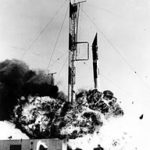
A major disaster at the Julianehåb launch facility has left 3 dead and a major clean up operation. GOSsiP had made a brave attempt to leapfrog the other space agencies by launching an interplanetary satellite on a lunar fly-by mission. The initial launch attempt on the 15th of December was delayed with just one second before ignition of the two stage rocket when sensors detected a malfunction in the rocket motors. The launch was rescheduled to the 30th of December. On the relaunch the countdown was proceeding normally until the ignition phase of the rocket. At T-3 seconds, the rocket exploded on the launch pad in a catastrophic explosion. The launch pad itself was badly damaged in the explosion and will require repairs costing $25,000,0001.

Further investigation into the accident has revealed that the clockwork mechanism used to correctly sequence the flow of fuel and oxygen into the rocket motor cowling had been installed upside down, causing a major build up of the fuel and oxygen mix before the ignition of the combination and then leading to the major explosion. GOSsiP researchers have, in a major scientific breakthrough, been able to replace the mechanism with a new transistorised version that has asymmetric connectors and hence cannot be installed in the incorrect orientation2. GOSsiP's one stage rocket starts 1959 with a safety rating of 26%.

Honohulu repaired; Corruption in R&D

SHADO's Honohulu launch facility has now been repaired following last years launchpad explosion and is being prepped for another launch attempt currently scheduled for the 10th of December 1959. As the repairs at Honohulu continued, more research into both the one stage rocket (safety rating now 48%) and the interplanetary satellite (safety rating now 39%) were made during the year.

Also reported from Honohulu has been the discovery of nefarious practices within SHADO's research and development programs which have reportedly diverted money from actual research and into extensive (and expensive) beach parties on the north shore of Oahu Island nearing the main viewing area for the rocket launches. Suggestions that some of the expensive barbecue equipment was supplied by South African companies ultimately connected to that country's secret police have been denied by both SHADO and SARSA3.

Mass roundup of spies in South Africa

SARSA has released a press statement condemning what it called "a concerted and mass attempt at espionage". It has accused all the other agencies of attempting to acquire its advanced space technology. It has reassured all concerned that, had it any undeveloped space programs it would have ensured that the leaking of that program to its competition4

Woomera also promotes reuse

In an apparent attempt to learn from Smaug Inc.'s experiments into the use of sea water to allow the quick turnaround of launch facilities, the Australian Space Agency has reported that it is conducting experiments into similar technology using the amber nectar instead of sea water. Officials explained that "as Woomera is hundreds of kilometers from the sea we obviously cannot use sea water as the coolant mechanism. We do have to keep a large supply of the beer for use on the facility, so we thought we'd see if it can be used in a similar fashion to that reported to be used by Smaug Inc."5

Flu outbreak forces consideration of backup crews

Following the major worldwide breakout of Influenza, Smaug Inc., is reportedly considering the assignment of backup crews to its future manned flight plans. If a manned launch had been planned for this year without a backup crew in place, the outbreak would have caused Smaug Inc. to scrub the launch as a result of the outbreak6.

Slow start for Smaug Inc.

Smaug Inc. has started a two stage rocket program, but the program has had a slow start reaching the dizzying safety factor of 16% in its first year of research. Smaug Inc. also improved the safety rating of its orbital satellite program, which reached a safety rating of 51%.

Big rockets for SARSA

SARSA is aiming both big and high with its new three stage rocket program codenamed "BFL 3". With rapid (if expensive) progress into this program, the BFL 3 already has a safety rating of 27%, while the one stage rocket was also the beneficiary of research with its safety rating raised to 85% (the maximum rating this rocket can be increased to by research).

Astronaut program started at ASA

The Australian Space Agency has started an extensive training program for its astronauts with an initial intake of three crew members. The Commander, Steve Zodiac, is reported to have escaped serious injury when someone planted a loosely lidded paper cup full of hot coffee in the training centrifuge. It is a mystery as to how the offending cup got in there as security was tight and only the three astronauts were anywhere near the vicinity at the time of the exercise. Dr Venus was unavailable for comment. After a quick sponge down the interior of the centrifuge capsule was as good as new.

Excellent progress on the two stage rocket (now at a safety factor of 68%) and the three person capsule (safety rating of 53%) has been achieved by ASA despite a slight scaling back of the research plans. Despite the lack of immediate plans for launches, ASA is looking forward to future missions with the purchase of an additional two stage rocket.

Launch Calendar

The provisional calendar for launches planned in 1959 (assuming none of the missions are rushed or scrubbed) is as follows:

10th Dec
Launch by SHADO
20th Dec
Orbital Satellite from SARSA7

Last updated: December 21, 2021 at 19:38 pm

Footnotes

  1. As the explosion killed people on the ground, this counts as a catastrophic failure and reset the safety factor of GOSsiP's two stage rocket back to 10%.
  2. GOSsiP's event card was a major scientific breakthrough in its most advanced rocket program.
  3. Subtract one from each of SHADO's research dice during 1959
  4. Counter-espionage - SARSA could have reduced a competitor's research program to the safety rating of its own equivalent program. However as all its programs are better than all those with the same program this has no effect.
  5. One time only (in a year chosen by ASA) one of ASA's facilities may be used twice in the same year. The second launch will be made on the 31st of December and must be planned in advance in the usual manner.
  6. Event card was "Influenza Outbreak", but as Smaug Inc. has no manned launches planned (or even an astronaut program), this has no effect. Note that having an assigned backup crew for a mission requires that backup crew is not the primary crew for another planned mission
  7. As ordered by South African government during 1957

1958 Smaug Summary

First published 17th May 2017 (Last Modified 21st December 2021)
Program Units Safety Factor
1. Orbital Satellite 1 51%
B. Two Stage Rocket 1 16%
c. Three person capsule 5 34%

1 Launch Facility at an undisclosed location.

One year, at the choosing of Smaug Inc., a launch facility may be used twice in the same year. The second launch will be made on the 31st December. The launch must be planned in advance as usual.

No launches planned for 1959


Last updated: December 21, 2021 at 19:38 pm

1958 SHADO Summary

First published 17th May 2017 (Last Modified 21st December 2021)
Program Units Safety Factor
1. Orbital Satellite 2 71%
2. Interplanetary Satellite 1 39%
3. Lunar Probe 1 10%
A. One Stage Rocket 2 48%

1 Launch Facility at Honolulu.

1 Launch planned for 1959


Last updated: December 21, 2021 at 19:38 pm

1958 SARSA Summary

First published 17th May 2017 (Last Modified 21st December 2021)
Program Units Safety Factor
1. Orbital Satellite 1 96%
A. One Stage Rocket 1 85%
C. Three Stage Rocket 1 27%

1 Launch Facility at an undisclosed location

1 Launch planned for 1959


Last updated: December 21, 2021 at 19:38 pm

1958 GOSsiP Summary

First published 17th May 2017 (Last Modified 21st December 2021)
Program Units Safety Factor
2. Interplanetary Satellite 0 69%
B. Two Stage Rocket 2 26%
c. Three Person Capsule 1 10%

1 Launch Facility at Julianehåb. This facility is badly damaged and must be repaired at a cost of $25,000,000 before it can be used for launches again.

No Launches planned for 1959


Last updated: December 21, 2021 at 19:38 pm

1958 ASA Summary

First published 17th May 2017 (Last Modified 21st December 2021)
Program Units Safety Factor
B. Two Stage Rocket 2 68%
c. Three Person Capsule 1 53%

Astronauts

Name Completed Flights
Colonel Steve Zodiac 0
Captain Ken Ross 0
Professor Matthew "Matt" Matic 0

1 Launch Facility at Woomera

One year, at the choosing of ASA, a launch facility may be used twice in the same year. The second launch will be made on the 31st December. The launch must be planned in advance as usual.

No Launches planned for 1959


Last updated: December 21, 2021 at 19:38 pm

1959

Another Firework display on Hawaii leaves 10 dead

Another display from SHADO

As if to show that the national holiday is set to become an annual event, another large explosion has been reported from the SHADO launch facility near Honolulu. The one stage rocket carrying an orbital satellite exploded on the launch pad killing 10 technicians on the ground. An initial investigation has shown that this rocket suffered a similar failure to that of GOSsiP's launch last year, but the near total destruction of the rocket and the launch site has meant that firm details on the cause of the problem is proving difficult to ascertain.1

Sabotage ruled out at SARSA

Despite the ruling out of sabotage as the cause of the failure of the suspected South African spy satellite, Johannesburg has imposed a significant budget cut to SARSA before approving the transfer of funds to the agency. On the 20th of December, a launch from SARSA failed when the rocket carrying the government satellite exploded at a height of 15,000 feet. The initial countdown proceeded normally and the explosion was the first (and last) sign of trouble with the mission. Fortunately the rocket's height at the time of the explosion avoided any ground casualties and so the safety rating of SARSA's one stage rocket remains unchanged at 85%.

Suspected surveillance operations

After unexpected progress at SARSA in their interplanetary satellite program many agencies, including at GOSsiP, have blamed loose talk2. GOSsiP also suspect that some of the data on their one stage rocket program may have helped SARSA's three stage rocket program, although GOSsiP's scientists did express surprise that a program whose main achievement to date has been a large crater could possibly help anybody's program!

Meanwhile attempts in Australia to close the many bars and pubs surrounding the Woomera launch facility following the discovery of a major leak in the three person capsule program has met with outright rejection by the staff at the facility. Smaug Inc. is suspected of using espionage to raise the safety factor of their three person capsule to match that of ASA's similar program.3

Dr. Venus' bug discovery

The discovery of a nest of a venomous spiders infesting the newly installed electronics in ASA's three person capsule has important safety implications for the future say independent experts. Dr. Venus was in charge of rechecking the capsule for safety and cleaniness following a recent ground test of the capsule. Her discovery of a colony of funnel-web spiders hiding in the clothing lockers of her male colleague's lockers has led to both a major review of the capsule's safety features and to her induction into ASA's astronaut program. It is expected that she has averted at least one major capsule problem that might have occurred in flight4.

Spam in a can furore

The description by Einar Gerhardsen, prime minister of Norway, of Maja Hansen as Spam in a can, just waiting to be cooked. has caused outrage at the agency, and a general reluctance to apply for further positions as astronauts at the agency. While the agency admitted that part of the crater at Julianehåb was now used for Summer Solstice barbecues, it said that it has yet to kill any astronauts and it did not recognise the situation described by the prime minister.5

Big science push at SHADO

SHADO has embarked a major mission to promote science and provide additional education into mathematics and probability theory. Although the results have not yet been reflected in successful launches, it is expected that this push will be reflected in research conducted by the agency during 19606.

Calls for review of R&D at GOSsiP

After the very slow progress on the revamp of the two stage rocket program at GOSsiP (now rated with a safety factor of just 36% after some concerted research efforts), many at the agency are calling for a review of the research methods used and have threatened the research team with a whole scale review of the program7

Lift off is a dangerous venture

Since the beginning of the space race, attempting to get anything off the ground has proven to be a dangerous business. So far, of the five launches attempted, three have exploded on the launch pad, one shortly after launch and only one has so far made into space and into orbit. Observers note that lift off from the launch pad is one of the most dangerous parts of any space mission, with the theoretical re-entry stage of a capsule also being described as quite risky if anything goes wrong.

Launch Calendar

The provisional calendar for launches planned in 1960 (assuming none of the missions are rushed or scrubbed) is as follows:

10th Oct
Launch by GOSsiP 8
15th Dec
Manned Launch of at least two crew members by ASA as ordered by the Australian Government in 1955
20th Dec
Launch by Smaug Inc.

Last updated: December 21, 2021 at 19:38 pm
31 May 2017

Updated to reflect launch window of GOSsiP's planned mission

27 July 2017
Clarified footnote 4


Footnotes

  1. As the explosion killed technicians on the ground, this explosion counts as catastrophic and reduces the safety factor of SHADO's one stage rocket program to 10%. In addition the launch facility requires $25,000,000 of repairs before it can be used again
  2. Espionage by SARSA has raised the safety factor of their Interplanetary satellite program to match that of GOSsiP and in addition a small improvement to the three stage rocket program has been made following the results of the espionage program.
  3. Yep another espionage event, this time for Smaug Inc.!
  4. The first failed safety check in a capsule program made by ASA will be ignored and the mission will proceed to the next safety check.
  5. Note, no new astronauts may be recruited by GOSsiP during 1960.
  6. +1 per R&D die purchased by SHADO during 1960.
  7. I did feel that rolling just 10 on 6d6 was quite a lot on the unlucky side!
  8. Launch in October to met launch window of desired mission.

1959 ASA Summary

First published 31st May 2017 (Last Modified 21st December 2021)
Program Units Safety Factor
B. Two Stage Rocket 2 85%
c. Three Person Capsule 1 90%

Astronauts

Name Completed Flights
Colonel Steve Zodiac 0
Captain Ken Ross 0
Professor Matthew "Matt" Matic 0
Dr. Venus 0

1 Launch Facility at Woomera

One year, at the choosing of ASA, a launch facility may be used twice in the same year. The second launch will be made on the 31st December. The launch must be planned in advance as usual.

First capsule failure will be ignored.

1 Launch planned for 1960 (Manned mission in a multi-person capsule as ordered by the Australian Government in 1955.


Last updated: December 21, 2021 at 19:38 pm

1959 GOSsiP Summary

First published 31st May 2017 (Last Modified 21st December 2021)
Program Units Safety Factor
2. Interplanetary Satellite 1 69%
B. Two Stage Rocket 2 36%
c. Three Person Capsule 1 10%

Astronauts

Name Completed Flights
Maja Hansen 0

1 Launch Facility at Julianehåb.

1 Launch planned for 1960


Last updated: December 21, 2021 at 19:38 pm

1959 SARSA Summary

First published 31st May 2017 (Last Modified 21st December 2021)
Program Units Safety Factor
1. Orbital Satellite 0 96%
2. Interplanetary Satellite 1 69%
A. One Stage Rocket 0 85%
C. Three Stage Rocket 1 45%

1 Launch Facility at an undisclosed location

No Launches planned for 1960


Last updated: December 21, 2021 at 19:38 pm

Updated year of launches